The Meaning of Gold in Japanese Culture
More Than Precious Metal
In the West, gold is largely synonymous with wealth. It adorns the powerful, fills vaults, and measures economic confidence. It is, above all, a symbol of material value.
In Japan, gold carries a profoundly different weight. It is spiritual before it is financial. It represents illumination, transformation, the divine made visible. It is applied not to impress, but to elevate — to take something earthly and connect it to something greater.
Understanding this distinction changes how you see gold entirely. And it changes how you understand Kintsugi, the art form at the heart of everything we do.
Temples of Light
The most famous expression of gold in Japanese culture is Kinkaku-ji — the Golden Pavilion in Kyoto. Built in 1397, its upper two floors are covered entirely in gold leaf, creating a structure that seems to float between the real world and the sacred.
But Kinkaku-ji is not a display of wealth. It is a representation of paradise — a Buddhist pure land made manifest in architecture. The gold is not decorative; it is devotional. It catches the light of every season: the pale winter sun, the green reflections of summer maples, the fiery glow of autumn. The pavilion changes constantly, reminding visitors that even what appears permanent is always in flux.
This devotional use of gold extends throughout Japanese sacred spaces. In temples and shrines across the country, gold leaf is applied to altars, statues, screens, and ritual objects — not to make them expensive, but to make them luminous. Gold, in Japanese spiritual practice, represents the light of enlightenment itself.
Gold in Japanese Art
The artistic use of gold in Japan reaches extraordinary heights in two traditions: folding screens (byōbu) and lacquerware (maki-e).
Folding Screens
Japanese folding screens from the 16th and 17th centuries — the golden age of the Momoyama and early Edo periods — used expanses of gold leaf as both background and atmosphere. In works by masters like Hasegawa Tōhaku and the artists of the Kanō school, gold was not merely a color choice. It represented:
- Clouds and mist — gold areas dissolving into the composition like weather
- Sacred space — an otherworldly glow that separated the scene from ordinary reality
- Ambient light — in the dim interiors of castles and temples, gold leaf caught and reflected candlelight, making the images seem to shift and breathe
The gold in these screens was never static. It responded to the viewer's movement, the time of day, the quality of light in the room. It was, in a very real sense, alive.
Lacquerware
Maki-e — the art of gold-dusted lacquer — developed over more than a thousand years into one of the most refined decorative arts in human history. Artisans would sprinkle gold powder onto wet lacquer in layers so fine that the result appeared to glow from within. Writing boxes, tea caddies, incense containers, and personal accessories were transformed from functional objects into meditations on beauty.
The patience required was immense — a single maki-e box might take months of layering, curing, and polishing. The gold was not applied in a single gesture. It was accumulated, slowly, like wisdom.
Gold as Transformation
This is the thread that connects all these uses of gold in Japanese culture: gold as the substance of transformation. It takes the ordinary and makes it sacred. It takes the dark and fills it with light. It takes what is broken and makes it whole.
This is exactly what happens in Kintsugi.
When a potter repairs a cracked bowl with gold-laced lacquer, they are doing more than fixing a dish. They are performing an act of philosophical transformation. The gold says: this is where the break happened, and this is where something beautiful was born. The damage becomes the most precious part of the object — not in spite of the gold, but because of what the gold represents.
Gold, in the Kintsugi tradition, is the visual language of resilience. It marks the places where something survived.
How Gold Lives in Our Work
At KintsugiBo, gold is not an accent color — it is the central metaphor of everything we create. It appears in every piece we make, but never in the same way twice.
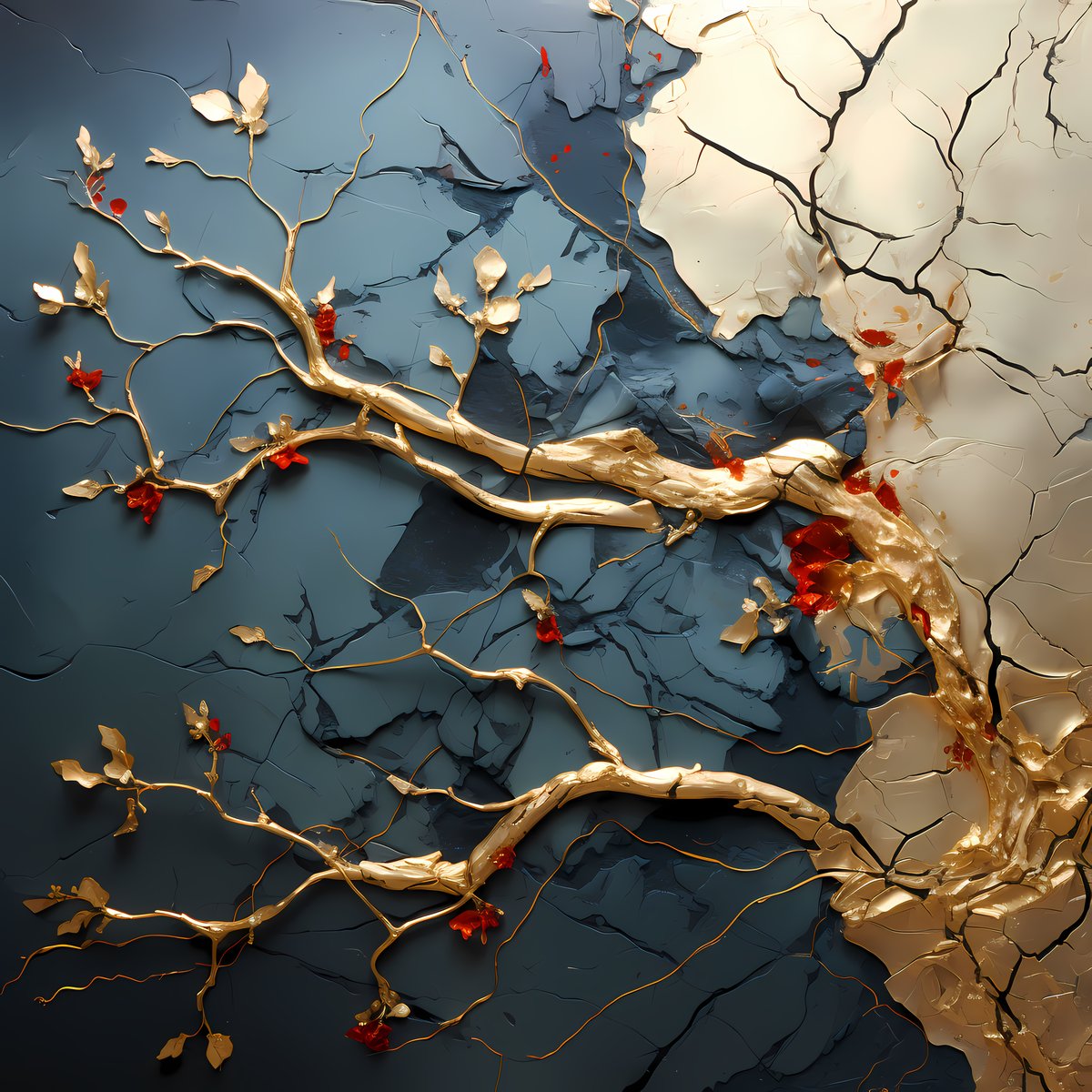
In Gilded Arbor, gold flows through branching forms like sap through a tree — organic, alive, following paths that feel inevitable rather than imposed. It suggests that nature itself knows how to repair, how to find light in the darkest places.
In Twilight Bough, gold emerges at the edges of twilight, catching the last light of a day that is ending. There is something tender about it — gold as a gentle presence rather than a bold one, a reminder that beauty persists even as things fade.
And in Death of a Dragon, gold appears at the moment of dissolution — a great power transforming into pure light. Here, gold is not gentle. It is fierce, radiant, and final. It represents the ultimate Kintsugi act: the transformation of ending into illumination.
Each piece uses gold differently because the philosophy is not a formula. It is a living idea, and it expresses itself according to the emotional truth of each composition.
A Different Kind of Wealth
The Western association between gold and monetary wealth is not wrong — it is simply incomplete. Gold does represent value. But in Japanese culture, the value it represents is spiritual, emotional, and philosophical before it is economic.
When you hang a piece of art that features gold — not as luxury, but as light — you are participating in a tradition that spans centuries. You are saying that the most valuable things in your home are not the most expensive. They are the most meaningful.
Gold catches the light. But more importantly, it catches the eye, then the heart, then the mind. In Japanese culture, that journey — from surface to soul — is what gold has always been about.
See gold as the Japanese masters intended. Explore Gilded Arbor, Twilight Bough, and Death of a Dragon in our collection.
Geschrieben von
KintsugiBo
Wir feiern die Unvollkommenheit durch Kintsugi-inspirierte Kunst.